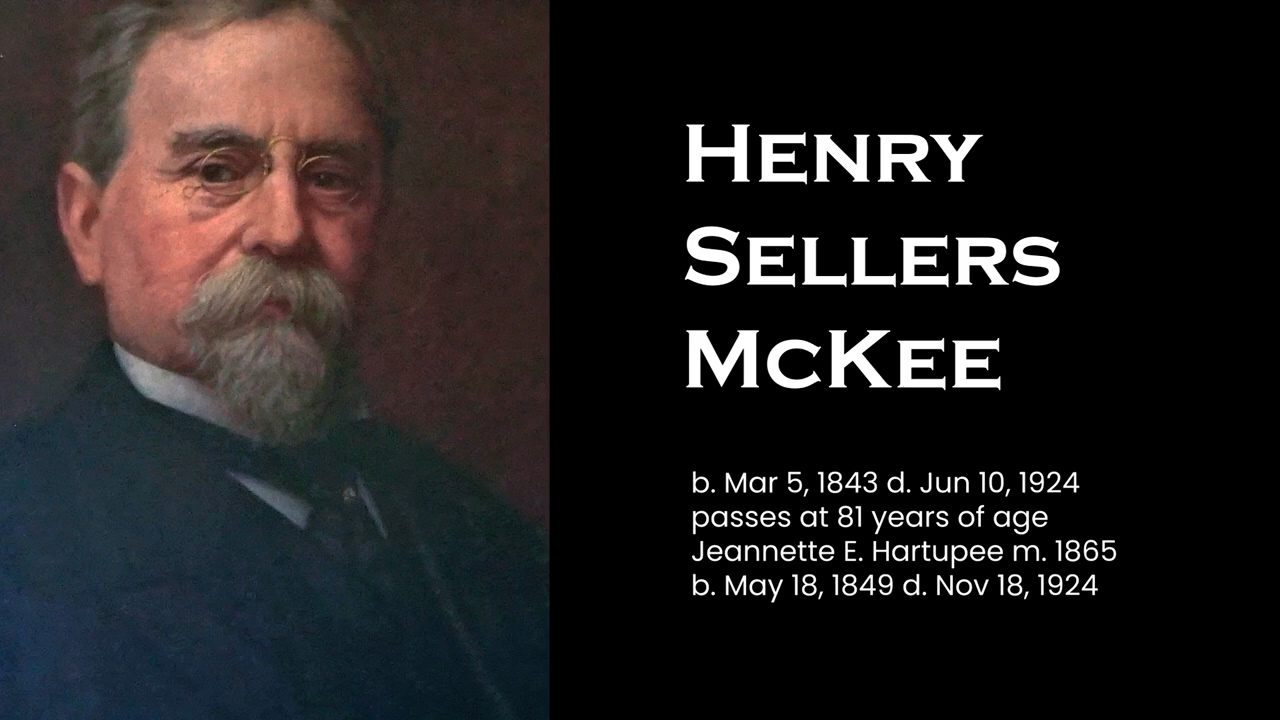
Learn about Henry Sellers McKee, the only McKee brother from McKee Glass to live beyond 40 years of age. He was born March 5, 1843 and died June 10, 1924. His wife was Jeannette E. Hartupee, daughter Andrew Hartupee and sister of William D. Hartupee. He was a glass manufacturer but also was a capitalist, investing in banks, insurance companies and railways. His partners were may but included James Chambers and Murry Verner.
He would also have to contend with the many scandals of his son Andrew Hartupee McKee who married Lydie Sutton, then Cornelia Baxter Tevis but had an affair with Genevieve Chandler Phipps and, a few years before his death, Alice Levy.
His son Thomas McKee would become a New York stock broker and own two houses that still stand today. One is the Chalfant House at 915 Ridge Ave - originally built by Thomas McKee. The other is in Beverly Farms, MA. He also owned yachts such as the Senta and Amorita. He married twice. His first wife was Nellie Foster Wood and remarried after his divorce to Alice Wagner.#
pittsburghhistory #glassmanufacturing #antiqueglass #tractioncompanies #streetcars #southside #southsidepittsburgh
Transcript
[Intro music] 00:00:00:00 - 00:00:30:02
Hi, this is Melanie from Artifact and Landmark. Today's episode is about Henry's Sellers McKee, who often just went by Sellers. He is one of the five brothers who ran McKee & Brothers, a Victorian glassworks which operated out of South Side Pittsburgh, then known as Birmingham. He was born into this iconic glass family but would be the only son to live past the age of 40 years.
00:00:30:05 - 00:00:55:00
Sellers, of course, led a busy life and a productive life as an industrialist and a capitalist. You will see many companies, business leaders and controversies attached to this man and his career. He formed many partnerships with a few that stand out. The first is James Chambers, who was a window glass manufacturer, and the other one is Murray Verner, a railway entrepreneur.
00:00:55:02 - 00:01:21:11
With this story, we also pay our respects to his brothers. James, who passes at 26. Frederick who passes at 37, William who passes at 34, and Stewart who passes at 40. Sellers started his life on March 5th, 1843 in Birmingham, again now known as South Side Pittsburgh. His parents were Thomas McKee and Hettie Zillhart. He stood at five foot four inches, had dark eyes and black hair.
00:01:21:15 - 00:01:46:00
He was the fourth of the five sons and also had three sisters that would live into adulthood. So let's get started with the story of Henry Sellers. When Sellers was born on March 5th, 1843, his father Thomas, would have been busy building a glass manufacturing and dry goods business with his two brothers, Samuel and James. This company was styled as S McKee & Co.
00:01:46:02 - 00:02:09:17
They lived at 1005 Bingham Street. His father's factory would be a short distance at what is today Sarah and 13th streets. By the age of seven, his two brothers, Frederick and James, were busy building their own glass factory, at first partnering with Bryce Brothers, and then they would strike out on their own a few years later, creating F & J McKee.
00:02:09:19 - 00:02:36:25
By all accounts, his education was at public schools in Birmingham. The first brother to attend university would be his younger brother Stewart. Unfortunately, death seems to visit this household much too often. Although five brothers do survive into adulthood, many of Sellers’ siblings would never reach adulthood. Sellers would see three of his brothers passed before he himself reaches adulthood.
00:02:36:27 - 00:03:02:02
Two of these brothers would pass in 1855, David at age 15 and James at 26, one of the founders of F & J, the key. Sellers would have only been about 12 years old at the time. A few years later, in 1857, we see the arrival of Seller's first nephew, Frederick W McKee, the son of his brother Frederick and Melissa McKee.
00:03:02:04 - 00:03:30:18
Although this is speculation, this arrival may have prompted his father Thomas to retire from S. McKee & Co to better help his son Frederick with the glassworks. Thomas, though, would have actually been involved with some other businesses in Birmingham – the Birmingham Bridge Company and the Monongahela Water Company, which may have also contributed to his retirement. Sellers would have been 16 years old when he sees his older brother, William join the glassworks in about 1859.
00:03:30:20 - 00:03:58:16
With this addition, we see the company change its name to F McKee & Brother. That year we would also see his father Thomas elected to the board of the Birmingham Gas Company. Sellers himself will be attached to many gas works during his career. In 1861 we see the start of the Civil War. That same year, Sellers’ father becomes president of the Birmingham Deposit Company which will become the First National Bank of Birmingham after the National Banking Act of 1864.
00:03:58:18 - 00:04:23:15
His brother William will serve on the board and Sellers will eventually become President of this bank. The earliest mention of Sellers attached to the family's glassworks is in a directory printed in 1862. He's listed as a clerk at the works and would have been about 19 years old. A formal announcement is published in 1863 and with that announcement we see a new partnership between his brothers, Frederick and William
00:04:23:15 - 00:04:45:18
and, of course, Sellers. The firm also becomes McKee & Brothers, a well-known name in the world of glass collectors. We also see Stewart, the youngest brother, as a bill clerk at the firm. He may not have been fully engaged at the firm since we see him attending Western University of Pennsylvania, now known as University of Pittsburgh, where he is part of Beta Eta Prime.
00:04:45:21 - 00:05:15:18
In 1864, we see the passing of his father, Thomas, and the next year, in 1865, we see the passing of Sellers' brother Frederick, the last remaining founder of the glassworks. Frederick would have only been 37 years old at his passing but he would provide some very specific instructions at his death. He first makes it clear that he wants the business to continue as a partnership between the brothers but he also he wished them to sell one sixth of the business to Stewart, payable in ten years.
00:05:15:21 - 00:05:44:26
The executors, including Sellers, would also have been his children's guardian, which will become relevant as they reach adulthood with a lawsuit in 1881. On June 8th of that same year, in 1865, at age 22, Sellers marries Jeanette Hartupee. She would have been 16 years old, and was the daughter again of the prominent engineer and manufacturer, Andrew Hartupee. The next year, their first child, Thomas McKee, is born on August 13th, 1866.
00:05:45:04 - 00:06:14:23
In 1867, at the age of 24, we see him join his first bank as director at the Mechanics National Bank. In 1870, he welcomes his second son, Andrew Hartupee McKee on August 20th, 1870. Although Sellers will be associated with many banks during his lifetime, both in Pittsburgh and other cities, his longest relationship was with the First National Bank of Birmingham, again, of which he becomes president.
00:06:14:25 - 00:06:40:08
This bank was an offshoot of the Birmingham Deposit Company, of which his father, Thomas McKee, was President. He becomes director of this bank in 1871. That same year, in 1871, he forms a long term directorship in the insurance industry, joining as Director of the Western Insurance Company. In 1872 we see the passing of yet another brother, William.
00:06:40:13 - 00:07:11:28
He would have only been 34 years old, and unfortunately, on his death certificate the reason recorded is intemperance. The death of William leaves H. Sellers then 29, and his brother Stewart, then 27, as the sole remaining family members involved in this business. It's noteworthy to also mention that during this period, the country enters the Long Depression, which is generally said to last from about 1873 to around 1878 or 1879.
00:07:12:00 - 00:07:41:21
By 1876, the company relocates its offices and sample room to their factory situated at 18th Street. This isn't unusual, given that the railways were taking over the previous ways that freight moved around, which was on the rivers and canals. In 1878, we see the first mention of Sellers being attached to a railway. He became a director of the Pittsburgh and Castle Shannon Railway, and then he'll be much more interested in railways
00:07:41:21 - 00:08:09:07
with the onset of the era of electrification, especially the city passenger type railways. And of course, he forms a very strong business relationship with Murray Verner. Gladly, a tragedy is avoided in 1879 as Sellers’ son Thomas accidentally shoots himself with a revolver. Fortunately, after undergoing surgery, he recovers from his injury. In 1881, we find Frederick's children grown.
00:08:09:09 - 00:08:36:12
Frederick W is now 24 years old, and his sister Melissa is now 19. They file a lawsuit to gain control of their inheritance from their uncle Sellers. This case is contested by Sellers and goes to the Supreme Court. They're successful in obtaining the release of their father's estate, which had grown in value. The value estate, which had been managed by Sellers, was valued at a reported $200,000 and may have been much more.
00:08:36:13 - 00:09:03:20
In 1883, Charles W. Siemens, who happens to be the brother of the founder of Siemens AG, Werner von Siemens, filed suit against Sellers. Sellers seems to be caught up in Charles’ battle to recover his investment and patents related to the Siemens–Anderson Company, a steel company, which goes bankrupt in 1882 and was just established a year earlier.
00:09:03:23 - 00:09:33:26
The suit stems from an agreement McKee had made with Siemens and a share sale. Sellers purchases some of the property. Although Siemens dies in 1883, the estate continues tje suit. In 1885, the Merchants and Manufacturers National Bank of Pittsburgh, H. Sellers McKee and Robinson, Rae & Co., all creditors, will also file a lawsuit against the estate of Charles W Siemens and others on the grounds that the corporation was illegally formed.
00:09:34:01 - 00:10:01:00
That same year, in 1883, Sellers and another famous name in Pittsburgh history, Doctor Hostetter, look to gain control of the local gas market. We see them combine their companies, but a battle for control sees Sellers’ side pay $20,000 per share for that control. Despite this, Doctor David Hostetter, through purchases, will get full control of most of the gas in the region in 1885.
00:10:01:05 - 00:10:29:01
In 1884, we also see another loss in the family. His mother, Hetty McKee, passes on on June 24th, 1884. The next year, Sellers sees another brother pass, his only remaining brother, Stewart McKee, passes from rheumatism of the stomach on November 11th, 1885. He leaves behind a wife, Virginia, and son, J. Dalzell or James Dalzell McKee. He would also just go by Dalzell.
00:10:29:03 - 00:11:05:25
Since he died intestate. J Willis Dalzell, his wife's brother, is named administrator of Stewart's estate and this will become important. Stewart's death will ultimately launch the glassworks into a new era and Jeanette PA and refocused Sellers business interests. In October 1887, Sellers is faced with decisions when his brother-in-law, J. Willis files to have the common property of Stewart and Sellers divided on behalf of his nephew James Dalzell Mckee, then only four years old.
00:11:05:29 - 00:11:41:08
This includes the glassworks. We speculate that Sellers must have known this was coming, since he's already planning to move the glassworks out of Pittsburgh in 1886. We aren’t sure what prompted the filing by J. Willis Dalzell in October 1887, but another event, a fire on July 31st, 1887, certainly would have complicated matters. On that date, the McKee & Brothers factory, along with King Sons and Co, another glass factory, burned down from a reported spark created by a passing locomotive that sets fire to a shed on the King's property.
00:11:41:14 - 00:12:10:23
It's important to mention that during this time there would have been watchmen on duty at these factories, but it's unclear who witnessed the fire and reported its source. Also in 1887, Sellers is noted as a director of the Standard Plate Glass Company. This company would become important to his partner James Chambers, another board member and a window glass manufacturer who will go bankrupt that year.
00:12:10:23 - 00:12:39:13
We also see Sellers attached to more gas companies, this time the Chartiers Natural Gas Company, which is reported to manage about 75,000 acres. The following year, in 1888, we see Sellers partner up with James Chambers, but this time it's to establish a glass factory, the Chambers-McKee Window Glass Company in Jeannette, Pennsylvania. This city was established because of this work and the city is named after a seller's wife, Jeannette.
00:12:39:15 - 00:13:05:29
Co-located with the chambers. McKee Window Glass Company is the McKee & Brothers Flint Glassworks. In 1938, as part of the 50th year celebration of the move to Jeannette, PA we see the recreation of this great exodus of McKee & Brothers from Pittsburgh to Jeannette which originally was headed by Sellers in 1888. As part of this move we see Sellers,
00:13:05:29 - 00:13:36:08
in 1889, bring on board his son Thomas McKee into the business. After his graduation from Princeton University, his son Thomas will marry Nellie Foster Wood on November 27th, 1889. That year, Sellers and partners also set up the First National Bank of Jeannette, a real estate firm, and the Jeannette Gas Company, to provide housing as part of a larger plan to contribute to the growth of this city over the next few years.
00:13:36:08 - 00:14:04:11
With the advent of electric rails, Sellers quickly turns his interest in railroads by founding the Pittsburgh and Birmingham Traction Company with James Chambers and other founders. He also expands his network in 1890 by incorporating the Rochester and Brighton Railway, the Thomson Houston System, and the Buffalo and Suburban Rapid Transit Company, which would be managed by Murray Verner. In 1891,
00:14:04:11 - 00:14:45:16
Seller founds the Birmingham, Knoxville and Allentown Traction Company. In 1890, soon after the move to Jeannette, the Window Glass Company and James Chambers run into financial trouble. In 1890, the American Glass Trust is established with James Chambers as president, and eventually the Chambers and McKee company is sold off to the trust. In 1891, James Chambers assigns his assets to a trustee to be liquidated, which is said to be due to Sellers being unwilling to afford him or time to pay his debts, and one article Sellers is quoted I will neither hurt nor help Mr. Chambers.
00:14:45:19 - 00:15:18:25
One can only wonder with the two living next door to each other on Ridge Avenue what discomfort each must have felt during this period. In 1891, the McKeesport Fuel and Light Company of Pittsburgh, The Esplen Fuel and Light Company of Pittsburgh, The Homestead Fuel and Light Company of Pittsburgh and The Mansfield and Chartiers Fuel and Light Company are chartered with H. Sellers McKee, J. G. Ormsby, J. D. McCabe of Pittsburgh and William D. Hartupee of Charleroi as Directors.
00:15:18:26 - 00:15:50:04
William D. Hartupee is the brother of Jeannette and he'll also found the Charleroi Plate Glass Company, later sold to Pitt's Pittsburgh Plate Glass Company, what we call PPG today.
Sellers welcomes his first grandchild, Henry Sellers II on February 11th, 1891. On November 21st, 1892, Hart Sellers youngest son, marries Lady Sutton. They go on to have two children, Virginia and Harriet.
00:15:50:06 - 00:16:17:23
In 1892, H. Sellers, along with others buy the Citizen Street Railway Company. Sellers real business investments continue to be varied, with him frequently changing his position. Case in point, in 1894, Sellers McKee resigns as president of the Pittsburgh and Birmingham Traction Company due to having to focus on other business matters, but he is also rumored to have disposed of a large amount of his stock.
00:16:17:25 - 00:16:48:09
In 1895, McKee and Murray A Verner then invest and manage the Citizens Traction Company located in Indianapolis, Indiana. Verner becomes a longstanding partner in various traction lines and ventures with Sellers. These include the Citizen Passenger Railway, both Pittsburgh and Indianapolis, Pittsburgh and Birmingham Traction Company, the Rochester, New York Street Railway syndicate, and the Buffalo New York Street Railway system.
00:16:48:12 - 00:17:13:14
Sellers, along with Verner, would face a lawsuit attached to electrification of the Birmingham line in 1899. During this time, Sellers also continues to expand his role in other businesses. With his election in 1895 as president of the Pittsburgh Window Glass Company and as director of the Philadelphia Company, a fuel supplier. A personal note is that in 1896, H.
00:17:13:14 - 00:17:46:11
Seller's son Thomas house at 228 - now 915 - Ridge is destroyed during its construction by gas explosion, but he rebuilds. He eventually sells the home to Henry Chalfant, building a new home in the Beverly Farms, Massachusetts area. Oddly, unlike many of the houses of this era, both houses built by Thomas still stand in Pittsburgh and Beverly Farms. Sadly, in 1896, Sellers’ sister, Emma McKee, dies.
00:17:46:13 - 00:18:16:08
She leaves an estate worth $150,000, which Sellers is named as executor. In 1897, Sellers is a founder of a new town called Monessen,, Pennsylvania, along with his brother-in-law George Orlando Morgan, who marries Sellers’ sister, the widow Harriet McKee Lorenz, as well as James Schoonmaker. In 1898, Sellers becomes President of the National Association of Pressed and Blown Glass Manufacturers.
00:18:16:10 - 00:18:46:18
1899 McKee & Brothers becomes part of the National Glass Company with his son Hart named as Director. The family soon exits the glass manufacturing business for good. In 1901, the First National Bank of Birmingham, which Sellers has long served as President, is defrauded A. J. Schroth, its Bookkeeper. Schroth admits to misappropriating $35K and is sentenced to five years.
00:18:46:20 - 00:19:17:09
In 1904, Sellers McKee relocates to New York, New York, and the reasons for the relocation is in part due to his son Hart's many personal and business scandals. That year, one of Hart's controversies involved his purported involvement with Genevieve Chandler Phipps, who was on the verge of divorcing her husband, Lawrence C., a nephew of Henry Phipps. When Laurence suspects Genevieve of being unfaithful, he kidnaps their children.
00:19:17:11 - 00:19:42:09
This incident not only casts a spotlight on the Phipps family, but also highlights Hart's ties to This incident not only casts a spotlight on the Phipps family but also highlights Hart’s ties to Genevieve. At the same time, Hart’s marriage to Lydie is obviously nearing its end, with reports indicating a hefty settlement of $300,000. Their divorce is finalized in January of the following year, after which Hart quickly remarries, although not to Genevieve.
00:19:42:12 - 00:20:16:01
Additionally, in 1904,Lydie's father, Doctor Rhoads Stansbury Sutton, sues Hart for $100,000 in damages related to his stock recommendations concerning the Colorado Fuel and Iron Company. It's no surprise that Hart's affair with Genevieve abruptly ends, but it's even more surprising that he marries so quickly. And when rumors surface about his new involvement with Cornelia Baxter Tevis, a wealthy widow whose late husband was Hugh Tevis, he denies it.
00:20:16:03 - 00:20:44:20
Yet just a week after finalizing his divorce, he weds Cornelia on January 11th, 1905. The couple soon relocates to Paris and welcomes a son, Andrew Hartupee Jr, born February 4th, 1906, and the drama continues. In 1906, Sellers comes to the defense of Harry Thaw. You may already know where this is going, but his alliance is to his father, William.
00:20:44:24 - 00:21:16:13
As you probably know, Harry Thaw would be convicted of the murder of Stanford White, and that stemmed from White's relationship with his wife, Evelyn Nesbit. There are many videos about this murder and the subsequent events. In 1906, seller McKee sells his house at 911 Ridge Avenue for $50,000 to about $55,000, and he declares he is leaving Pittsburgh for good and intends on selling all of his property.
00:21:16:15 - 00:21:40:25
He does essentially keep his word on this, but although he was interred in New York, he is exhumed and laid to rest in the family plot in Pittsburgh just a year after his death.
We also find a reference to this family and a book. Sellers and his wife, Jeanette, spent some time in Europe, and in 1906, their encounter with Winthrop Eugene Schuyler.
00:21:40:27 - 00:22:08:01
It makes it into the author's book Three Men in a motor car. Hart would need a great deal of support from his parents when, in 1907, Hart, McKee's new wife, seeks a divorce. She is granted custody of their son. The proceedings are well publicized, and Sellers is quoted as calling her a little vixen. Oddly enough, Hart's first wife supports the divorce in 1911.
00:22:08:03 - 00:22:35:11
The McKee family sues for custody of her son in the Paris courts and the courts rules to place his son in the care of a professor.
So we see the two sons first Hart settle in Paris and his other son, Thomas, settling in New York and the Philadelphia area. His sons would be involved in yachting, and a son, Thomas, would own the Thomas owning the Cutter Senta and Schooner the Amorita.
00:22:35:12 - 00:23:01:24
He would also build a house in Beverly Farms, which again still stands today. It seems, though, that Thomas would ultimately reject this lifestyle. His son Thomas would also become a member of the New York Stock Exchange in 1909. We have a letter from Thomas to Frick from this period reaching out to him to let him know about his new business and offering his services.
00:23:01:26 - 00:23:31:14
In 1913, Sellers joins Thomas’ partnership. Sadly, that same year, in 1913, Thomas and his wife Nellie separate. They would soon divorce, and Nellie would remarry Alfred Edward Ells on July 28th, 1916. They would divorce and this split will cause a bit of a sensation.
Sellers gets involved in additional lawsuits. In 1910, Sellers sues Charles Schwab.
00:23:31:16 - 00:24:13:21
In 1911, Henrietta McKee’s heirs sue Sellers for mismanaging his Mother’s estate. In 1912, Murray A. Verner sues Sellers McKee for $80K which he says is due to him from the dissolution of their streetcar partnership.
Sellers withdraws from the partnership in 1922. Thomas leaves the partnership soon after, selling his business to Charles E. Clapp in 1923. The seller dies June 10th, 1924 and is initially buried in New York, but the next year, in 1925, he is removed to the Allegheny Cemetery.
00:24:13:23 - 00:24:49:18
His wife Jeannette dies shortly after him on November 18th, 1924. One newspaper reports that Sellers left a fortune of $10 million. The eldest son, Thomas, remarries Alice Wagner in 1925. She performed with the Ziegfeld Midnight Frolic atop the New Amsterdam Theater. Thomas dies in Manhattan on February 29th, 1940, at the age of 73. Hart remarries to Alice Levy on August 4th, 1927, in New York.
00:24:49:20 - 00:25:19:09
He passes on February 23rd, 1931, at the Hotel Plaza in New York at the age of 60. He is also buried at the Allegheny family plot with the inscription on his gravestone: “Act well your part. That’s where the honor lies.”
So as a closing note, it seems that seller McKee was spoiled for choice in his lifetime. In one account, he declined a chance to be part of what would eventually become Pittsburgh Plate Glass Company.
00:25:19:11 - 00:25:43:14
He moved to Pittsburgh, hoping to garner the support of James Jim Chambers, and Sellers McKee for his glass venture. At that time, McKee and Chambers were seen as the innovative minds of the industry. Described as “one yard wide and all wool” yet they offered Mr. Ford nothing but a chilly reception.
That's it for this episode. I hope you enjoyed learning a little bit about Henry Sellers.
00:25:43:14 - 00:25:47:16
McKee and his descendants.