
Today’s topic has me taking you back to a time when glassware was shipped in barrels and to the details of how this was done from an article published in Crockery and Glass Journal.So, let’s explore the best practices for packing glass tableware in barrels, as outlined in 1927, to minimize breakage during transport.
#antiqueglass #shipping1920s #1920s #packingglass #barrels #barrelshipping
Download the full article.
Transcript
[Intro music] 00:00:00:00 - 00:00:31:08
Hello, I'm Melanie, and this is Artifact and Landmark. Today I'm sharing an article from 1927 and a few additional images. So today's topic has me taking you back in time when glassware was shipped in barrels and to the details of how this was done from an article published in Crockery, Glass Journal, which was a leading journal of the day, and which was first published on November 28th, 1874.
00:00:31:11 - 00:01:02:20
Today, it's a great resource for those who love to research early American glass and the China industries. The author of this article is a Freight Container Bureau, which was part of the American Railway Association, which became part of the Association of American Railroads.
So barrels were a popular means of transportation for centuries. As you can imagine, they easily roll up and down wharfs and onto ships. Barrels became much less popular with the advent of World War II, when palletization was being standardized.
00:01:02:20 - 00:01:29:20
And of course, crates and boxes were becoming more popular. So let's explore these best practices for packaging tableware in barrels to minimize breakage during transport. So for this article, the Freight and Container Bureau did a survey and physically inspected barrels to get an idea of when and how breakage occurred, the construction of the barrels, and essentially how those barrels made it through the transportation process.
00:01:29:22 - 00:01:54:04
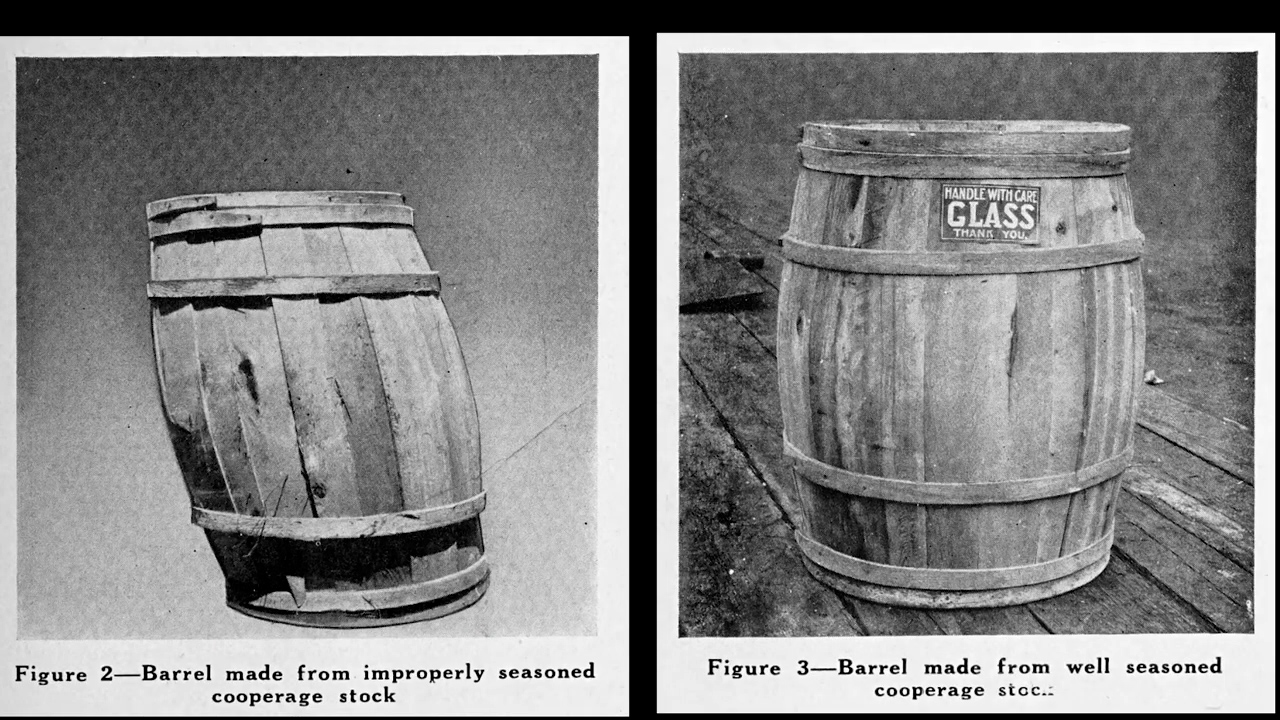
So they have two key takeaways that I think we'd all agree with. The first that that significantly affects how safely a shipment is sent is the actual barrel construction. Although I won't be delving into this part of the article, I'll definitely be posting it. You can see from this image, though, that on the left hand side, that the poor barrel construction could definitely lead to US breakage.
00:01:54:06 - 00:02:14:10
The barrel on the right hand side is an example a very well constructed barrel. If you'll also notice the label on the barrel, I actually happened to have the stamp in my collection, and the one of the reason I collected it is because I found it beautiful. It's made of copper. It's a nice wood, so it's always a reminder to that's not just the glassware that you can collect.
00:02:14:10 - 00:02:35:16
There's so much more to collect, including tools, molds, these stamps, advertisements, bill heads. There's so many things within this glass collection world that goes beyond the actual physical glass. So let's let's move on to the second point of this article, which is the second factor that can influence breakage, which is the packaging, how you package the glassware.
00:02:35:19 - 00:02:57:21
Here are some tips from this group. So first it says that each piece of glass should be wrapped in tissue or craft paper and a thin craft paper. And they say that packaging material like hay, straw and excelsior – and excelsior is just shredded wood – needs to be clean and sturdy, and it should be placed between the layers and against the sides of the barrels.
00:02:57:23 - 00:03:23:06
From their analysis, what they found is that hay was used 60% of the time, Excelsior was used 30% of the time, and straw was used much less at 4% of the time. In terms of the barrels that they examined and surveyed, it's also suggested that 1.5in of this packing material should be used against the sides of the barrels, and 3in on the top and the bottom.
00:03:23:13 - 00:03:48:21
And of course, that 1.5in between layers. They also point out that the type of glassware should have its own approach in terms of packing it, and we see that in these pictures here. So I'll run through them. First they show the stoneware being reversed tumblers either nested or tumblers upright. And of course put your 1.5in of cushioning, between each layer.
00:03:48:23 - 00:04:14:05
They also show that jugs should be reversed. Plates should be nested in groups of 2 or 3. And of course, if the plates are large, they should not be nested. Next, they talk about handling and shipping. They say, of course, to avoid tipping or storing the barrels upside down, since of course the lighter items should be at the top and the heavier items should be at the bottom, and of course, if you flip it, you will end up, potentially crushing.
00:04:14:06 - 00:04:37:07
those lighter items that are at the top. And they say before shipping that you should be actually checking your barrels, which may need to be repacked and the hoops may need to be tightened. Another point is, of course, securing the barrels during transport in the vehicle. And figure eight, they illustrate what they call a very dangerous situation, a very dangerous and insecure way of arranging the containers in the doorway of this car.
00:04:37:10 - 00:05:05:12
They say the barrel that is loaded lengthwise of the car on its bilge, rested up against the car door, has a potential of rolling out once the door, of course, is opened. And of course, if it's not noticed on time. And they say that many workmen actually overlook this point, and they say it's just as important to have the container as well braced in the cars as it is to have the wares well packed in those containers.
00:05:05:14 - 00:05:25:29
They highlight a couple of things in terms of breakage issues. They say that actually crushing was seen as the most common reason for damage, and crushing can occur, of course, if the barrels have rested before shipping or if they've been tipped over and then to a lesser degree, they say inadequate wrapping could lead to shipping damage.
00:05:26:02 - 00:05:50:04
But they also mention that if an item is wrapped too tightly, of course it can also lead to damage.
So that's it for this episode. I hope you enjoyed it and found it a fun topic. So join us next time to learn more about American Glass and its manufacturing.
